
Set pieces have become an increasingly interesting part of football.
I was first introduced to the ‘planning’ of them when I did some work experience with QPR, which was actually before I went to university. I’ll let you work out yourself how long ago that was.
There was a time when they were often treated as something of a secondary part of the game. Corners and free kicks were important, obviously, but they were rarely discussed with the same level as a lot of other tactical aspects. There was also a perception that set pieces were something for teams who needed another way to compete, rather than an area that the best teams should be investing heavily in. Think Stoke under Pulis, or the likes of Big Sam etc.
I think that perception has definitely now changed.
The growth of specialist set piece coaches is probably the clearest indication of that. Clubs across the Premier League and beyond now have people whose job is specifically to work on this part of the game. Brentford were early adopters of the specialist role, while coaches such as Nicolas Jover at Arsenal and Austin MacPhee, who moved from Aston Villa to Chelsea this summer, have helped make the role much more visible.
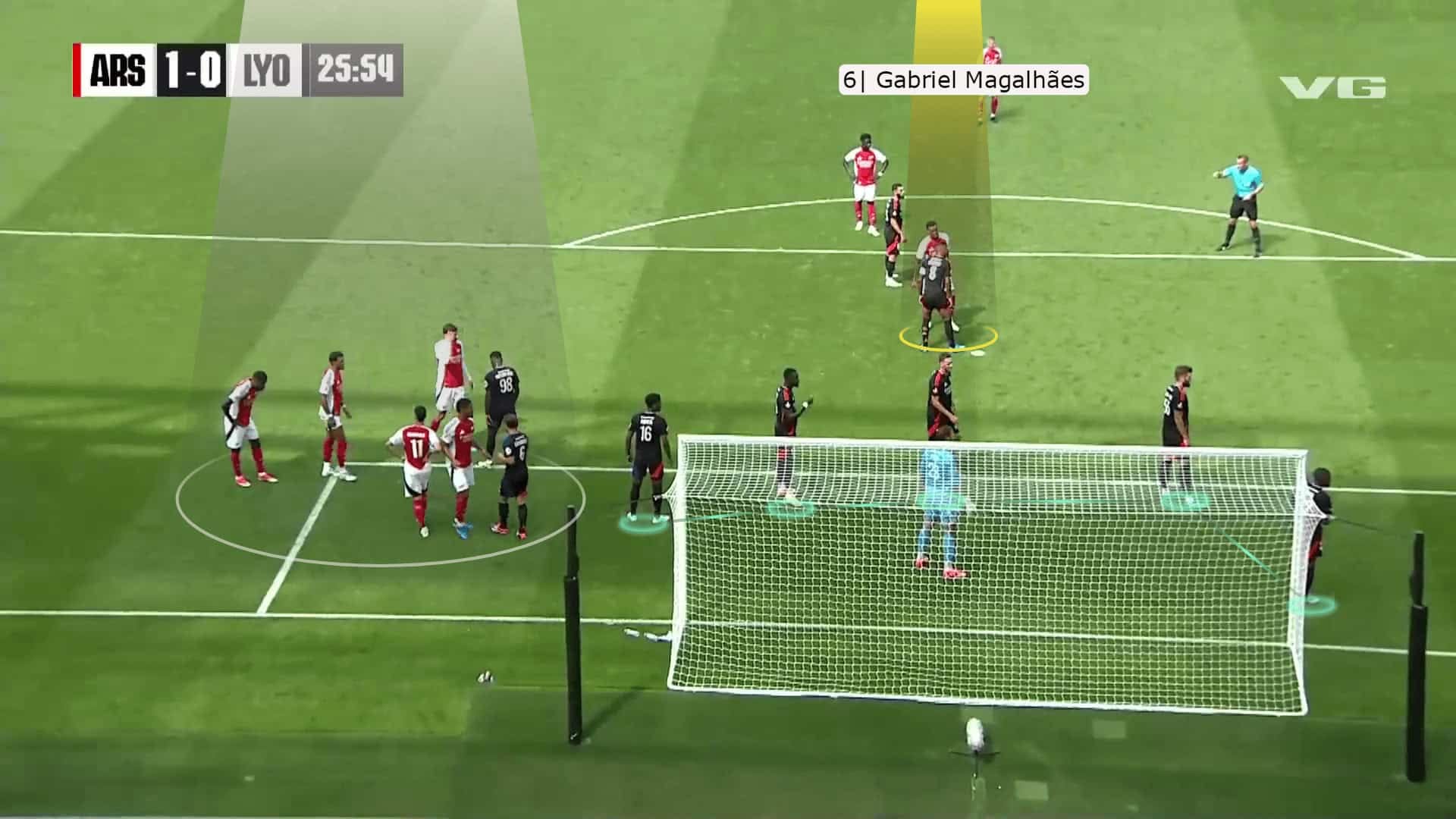
With the amount of money involved in the game (1 extra place in the Premier League being worth around £3m) you can see why any small edge is worth taking a look at. Set pieces account for a decent chunk of goals, so why not study them?
Arsenal are probably the obvious modern example. Since the start of the 2023/24 season, they have consistently been among the most productive teams in Europe from set pieces, with their corner routines becoming almost as recognisable as some of their open play patterns.
A set piece is one of the closest things football has to a designed play. That is perhaps why there is so much to learn from American sports such as baseball and American football, where repeatable situations have traditionally been analysed in enormous detail.
Football is obviously different. A corner does not happen in a vacuum. The quality of the delivery can change, the opposition can react differently, the goalkeeper can make a decision, the wind can affect the flight of the ball and the second phase can turn into something completely unpredictable.
But compared with open play, there is still a much greater degree of control.
You know where the ball is going to start. You know roughly where it is going to be delivered. You know where your players are going to begin. You can rehearse their movements. You can study how the opposition defends and you can try to create a sequence that produces the conditions you want.
That makes a set piece a problem to solve.
The first part of that problem is understanding the opponent. How do they defend corners? Do they use zonal marking, man marking or a hybrid? Which players are responsible for which areas? Where does the goalkeeper position themselves? Which players attack the first ball? Who protects the edge of the box? What happens if the corner is played short?
Once you understand that, you can start thinking about how to manipulate it.
Perhaps you want to move a particular defender away from an important area. Perhaps you want three players to attack the same zone before one of them changes direction. Perhaps you want to create a one versus one situation. Perhaps the objective is simply to create space for your best aerial player.
The routine itself is only part of it.
There is also the delivery, the timing of the runs, the starting positions, the blockers, the players attacking the first contact and the players responsible for the second ball. That is where the role starts to look less like someone coming up with clever corners and more like a combination of coaching, analysis and problem solving.
The data becomes particularly interesting here.
Tracking data can tell you much more than whether a player eventually scored. You can look at where players started, how they moved, where they ended up, how much space was created, which defenders were moved and which areas of the box were left exposed.
You might even discover that the most important player in a particular routine is the one who never touches the ball. Their movement might drag a defender away from the area where you actually want to attack. Their job might be to create space for someone else.
Video can show you that something happened. Tracking data can potentially help explain why it happened.
That also creates a fairly significant information management problem. You are potentially building a library of defensive shapes, marking systems, corner routines, free kick routines, preferred deliveries, player responsibilities and variations. You need to know what happened the last time you played that opponent, what they have changed since then and whether they have shown any new ideas in recent matches.
You also need to keep track of your own work. Which routines have worked? Which have created chances without producing goals? Which have been defended well? Which ones are opponents starting to recognise? Which players are most effective in particular roles?
And then there is the fact that this is not only about scoring. Defensive set pieces are just as important.
A club might spend hours trying to create a routine that produces a good first contact at the near post, while also spending hours working on how to defend exactly the same situation at the other end.
Where does the goalkeeper start? Who protects the near post? Who attacks the first ball? Who picks up the most dangerous opposition players? What happens to the second ball?All of these things can be coached and rehearsed.
One of the things I find interesting about the role is how much of it is about communication as well.
When I had Yannick Euvrard on the podcast, who was working as a set piece coach at Anderlecht before moving to Brighton, and he told me about the idea of having a set piece captain. The club captain was not necessarily the person responsible for organising the team during a set piece. Instead, a designated player acted as the link between the coaching staff and the players on the pitch.
That player knew the plan and helped make sure everyone else knew their role. It sounds like a small detail, but it says quite a lot about how specialised this area has become. A set piece plan is not particularly useful if it exists only in the coach’s head or on a presentation the players saw the day before.
The players have to be able to execute it. That means rehearsing it, communicating it and making sure the information reaches the players at the right time.
It also explains why the role of the set piece coach has become increasingly visible on matchday. Austin MacPhee is always shown on the TV when his team has a corner and at Arsenal, Nicolas Jover has become similarly visible to the point where Mikel Arteta has effectively handed over responsibility for set pieces during matches.
There is also an interesting question around how you measure all of this. Goals are obviously the easiest thing to understand. A corner that results in a goal is difficult to argue with.
But goals alone probably do not tell you whether a routine was good.
A team could produce a very good delivery, create a clear header and see it saved. Another team could score from a poorly executed routine because the ball happened to fall kindly.
So perhaps you want to look at the process as well as the outcome.
How many first contacts are you winning? How many chances are you creating? What is the quality of those chances? How often are you conceding shots from the second phase? Are you preventing the opposition from creating good opportunities at the other end? Set piece goal difference is one measure. Chance creation and chance prevention probably tell you more about the underlying process.
That is one of the reasons I think this area is so interesting from an analysis perspective. There is a lot of randomness involved in the outcome, but there is also a surprisingly large amount that can be controlled.
And once one club finds something that works, the other clubs have an incentive to work it out. If everyone knows how you defend a particular corner, you need another version. If a certain movement consistently creates space, opponents will eventually start preparing for it. If everyone starts using the same defensive structure, attacking coaches will start looking for ways to manipulate it.
It becomes a constant process of adaptation.
The more I have looked into the area, the more interested I have become in the less glamorous side of it as well. Not necessarily the routine itself, but the organisation of all the information that sits behind it.
If you are looking at opponents every week, storing routines, reviewing what happened, comparing different defensive structures and trying to understand which ideas are actually working, there is a lot of information to manage.
That was one of the reasons I ended up building Set Piece Studio.
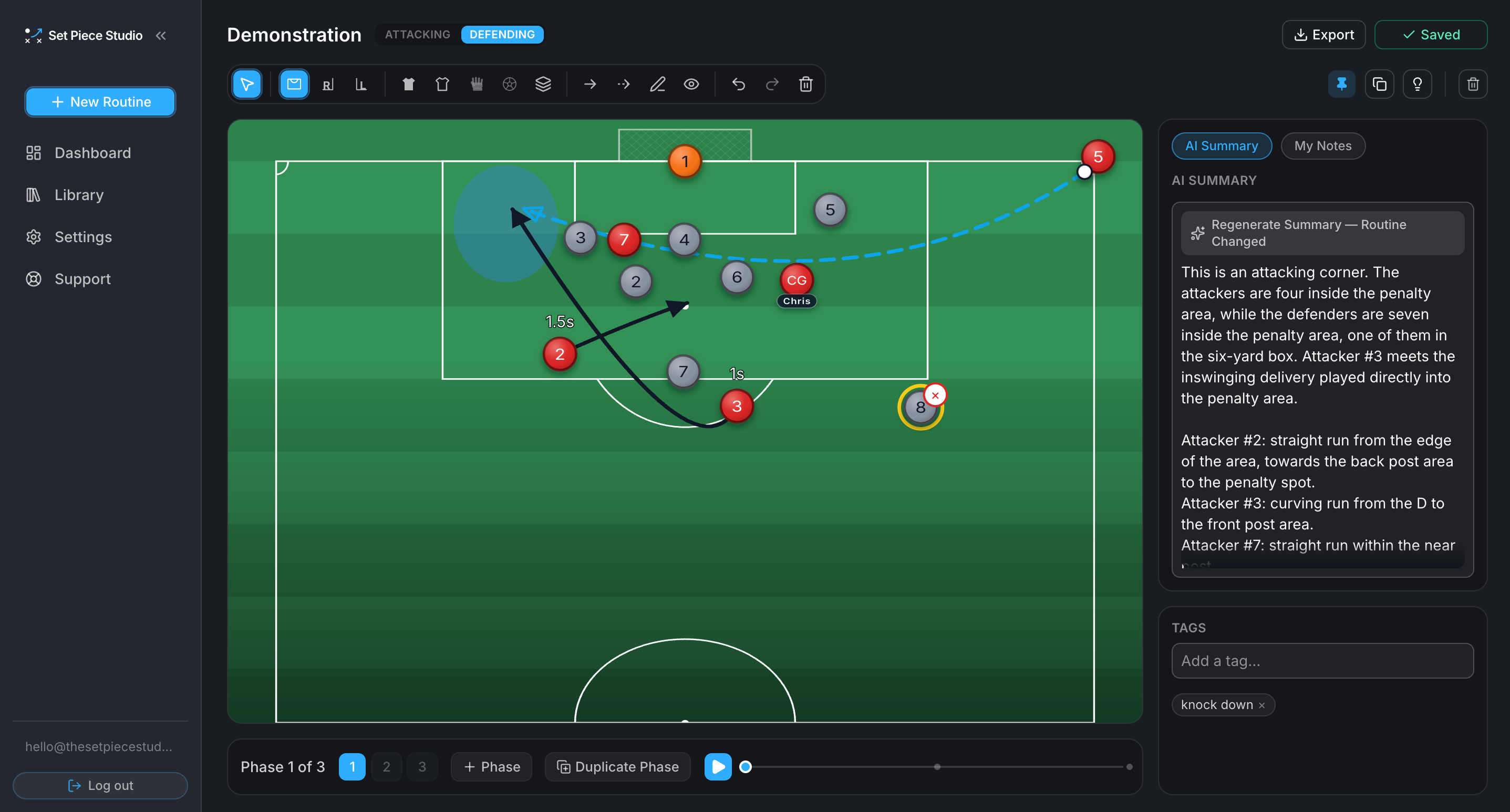
It is still very much in the early stages, and I am particularly interested in getting it in front of coaches and analysts who work in this area. I want to understand what is useful, what is missing and what could make the process of organising and reviewing set piece information easier.
I also have a couple of set piece coaches coming onto the podcast over the next few weeks, which should give us an opportunity to get into some of this in much more detail. If there is something you would like me to ask them, feel free to leave a comment or get in touch as usual.
The more I think about set pieces, the more I think the interesting question is not whether they have become more important. The evidence for that is fairly clear. The more interesting question is how much work goes into creating those supposedly simple moments in the first place.
The preparation behind it can involve opposition analysis, video, data, coaching, communication, training ground repetition and a lot of small decisions about where people stand and how they move.
That is probably why the modern set piece coach is becoming less of a specialist curiosity and more of a normal part of a football club’s analysis and coaching structure.
And I suspect we are still only seeing the beginning of where that can go.
Thanks for reading 👌🏼
Great article, Chris. My biggest takeaway is the concept of a dedicated set-piece captain; it’s a brilliant idea that I’m definitely going to incorporate into my own work.
Nice article, Chris